|
|
|
Search DOT-COM by
|
|
|
|
|
|
|
|
|
|
Resources and Events
|
|
|
|
|
|
|
|
|
|
About DOT-COM
|
|
|
|
|
|
|
|
|
|
| Frequently Asked Questions about the DOT-COM Alliance |
 What is the DOT-COM Alliance and what does it do? What is the DOT-COM Alliance and what does it do?
What is a Leader-with-Associates instrument?
Why should a Mission want to use this mechanism?
What are the steps for setting up an associate award?
Who do I contact at DOT-COM to request assistance?
Which Missions has DOT-COM worked with so far?
Who and what are Resource Partners? |
What is the DOT-COM Alliance and what does it do?
The DOT-COM Alliance is a USAID-funded program to promote the use of information and communications technology (ICT) to achieve development objectives.
DOT-COM works in all sectors, including education, economic growth, women in development, agriculture, trade, health, environment, and telecommunications/e-commerce policy. The DOT-COM Alliance consists of three USAID funded Leader-with-Associates cooperative agreements (CAs), each with specific areas of ICT expertise:
dot-GOV: Promotes policy and regulatory reform to create enabling environments for ICT. Lead organization: Internews Network with 21 Resource Partners.
dot-ORG: Extends ICT access to under-served communities and accelerates development-related uses of ICT (such as e-commerce and e-government). Lead organization: Academy of Educational Development (AED) with 63 Resource Partners.
dot-EDU: Strengthens education and learning systems through customized ICT interventions and content. Lead organization: Education Development Center (EDC) with 35 Resource Partners. |
What is a Leader-with-Associates instrument?
Three Leader-with-Associates Cooperative Agreements (CAs) have been awarded to implement the USAID DOT-COM program: dot-GOV (Lead organization: Internews Network), dot-ORG (Lead organization: Academy of Educational Development) and dot-EDU (Lead organization: Education Development Center).
The Leader with Associates (LWA) Cooperative Agreement is similar to a traditional cooperative agreement, except that it is designed to allow additional flexibility to facilitate participation by USAID Missions.
The "Leader-with-Associates" name reflects the fact that there is a single lead cooperative agreement, under which multiple associated awards can be made. The terms "Leader Award" and "Associate Award" refer to the relationship of the awards, and not to the issue of who receives the awards.
The Leader Awards were made after a competitive process to the organizations that serve as the prime awardees (also known as lead organizations). USAID Missions and Bureaus can develop additional stand-alone agreements or grants (Associate Awards) with the lead organization without repeating the competition process, so long as the Associate agreements or grants are within the scope of the LWA agreement.
Leader Awards generally fund core activities, such as short-term technical assistance and pilots, whereas Associate Awards generally fund specific projects and activities.
Associate Awards are made to the recipient of the Leader Award: sub-grantees and subcontractors are not eligible to receive stand-alone Associate Awards directly through this mechanism, but their involvement can be engaged in sub-grants and subcontracts through the lead organization.
Click here to download a PDF description (77K Adobe 4.0) of the Leader-with-Associates Instrument.
 To top of page To top of page
|
Why should a Mission want to use this mechanism?
It is a cooperative agreement and is pre-competed. That is, Mission staff can simply work with one of the three lead organizations (and through them, their resource partners) and save considerable time without having to develop RFPs/RFAs on their own, go out to bid, deal with competed contracts, and so on.
Each of the three lead organizations has a limited budget that allows us to go out and meet with Missions and work with them to evaluate how ICT can support their strategic objectives and develop program descriptions, which the Mission can use to develop an RFA for a DOT-COM Award.
Via this mechanism, Missions have access to the 99 DOT-COM Resource Partners, who represent an enormous range and scope of experience in ICT for development interventions. For more details about our partners, please visit the DOT-COM Resource Partner page.
To top of page
|
What are the steps for setting up an associate award?
Most Missions start by evaluating their strategic objectives to see how ICT can support them. By contacting one of the DOT-COM USAID Cognizant Technical Officers (CTO), Missions can enlist DOT-COM's assistance in this evaluation process.
Typically, there is a Mission visit that gives DOT-COM staff the opportunity to work with Mission staff to understand their needs and work with them to develop a draft program description.
The lead organization completes a draft program description and sends it to the Mission (with illustrative budget). The lead organization will often work with one or more of its Resource Partners in this process.
While this can vary, if the Mission is interested in moving forward with the activity, the Mission Contracting Officer sends the lead organization a formal request for application (RFA), often using the same language from the draft program description. At this stage the Mission may request the participation of any of the Resource Partners in the proposed activity.
After receiving the RFA, the lead organization will submit a technical and cost application, which will include sub-grants to any proposed or requested Resource Partners.
The Mission sends the lead organization any questions they might have on the application and together, USAID and the lead organization negotiate the final budget.
The "Associate Award" is made by working with USAID Washington -- again by contacting the relevant CTO.
To top of page
|
Who do I contact at DOT-COM to request assistance?
A Mission should contact the relevant USAID officer or lead organization, from one of the three "dots" or from DOT-COM.
To top of page
|
Which Missions has DOT-COM worked with so far?
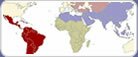
To date, DOT-COM has given field support to the following Missions and countries, many of which have resulted in signed associate awards. Click here for more information on DOT-COM Activities by Region.
|
AFRICA
Democratic Republic of Congo
Mali
Namibia
Nigeria
RCSA
REDSO/ESA
Rwanda
SADC/Botswana
Senegal
Sudan
Tanzania
Uganda
Zambia
|
ASIA AND NEAR EAST
Afghanistan
India
Indonesia
Iraq
Jordan
Laos
Lebanon
Morocco
Nepal
Philippines
Vietnam
Yemen
|
|
EUROPE AND EURASIA
Macedonia
Romania
|
LATIN AMERICA AND CARIBBEAN
Brazil
El Salvador
Guatemala
Haiti
Honduras
Nicaragua
Peru
|
To top of page
|
Who and what are Resource Partners?
DOT-COM is made up of 99 Resource Partners, representing a "who's who" of information and communication technology for international development. Resource Partners range from traditional NGOs, corporations, multilateral organizations, universities and foundations. Through the DOT-COM Alliance, Missions can access these Resource Partners through sub-awards via the three lead organizations.
For more details about Resource Partners, please visit the DOT-COM Resource Partner page.
To top of page
|
|
|